
A fully formed eye growing on a tadpole's belly, a frog's regenerated limb achieving perfect swimming form, and malignant tumors vanishing into thin air... These scenarios, which sound like science fiction, are actually happening in laboratories right now. We have long believed that DNA is the master architect of life, but a groundbreaking bioelectricity experiment tells us otherwise: DNA is merely a parts warehouse. What truly determines how you look, whether you get sick, and even whether you age is an invisible, intangible "bioelectric field map." Today, we peel back a corner of the textbook to reveal the true code that runs life at its most fundamental level.
DNA Was Never the Master Architect
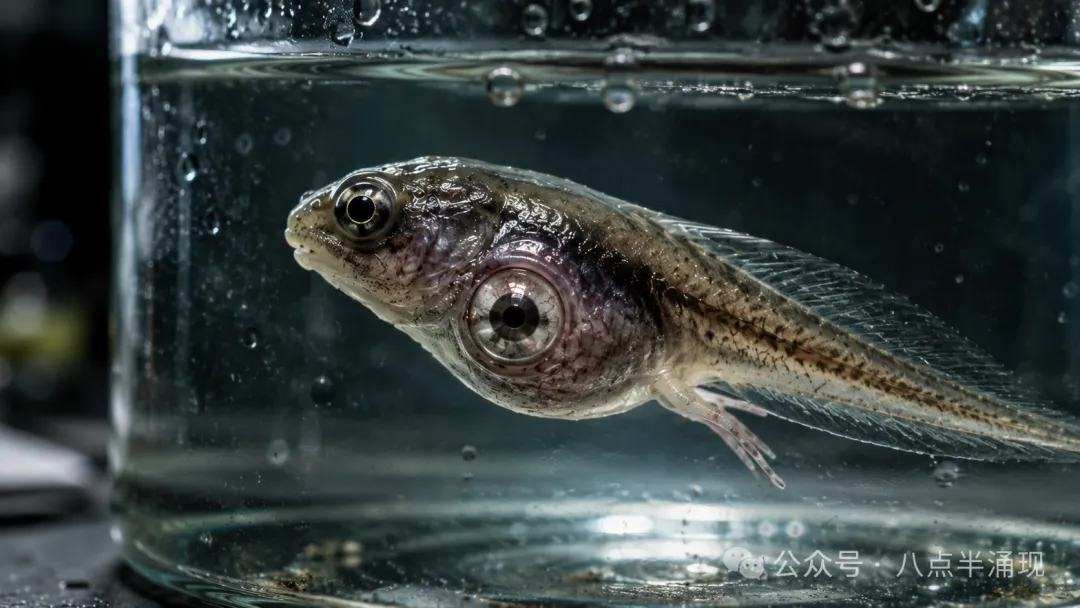
What you are about to see may be the most bizarre scene in the history of biology: a fully formed eye has grown on a tadpole's intestine. It has a retina, a lens, and even an optic nerve that automatically rerouted itself through the body to connect firmly to the brain. When scientists covered the tadpole's head eyes and shone a beam of light on its belly, it instinctively dodged. This is not gene editing, nor is it organ transplantation. Researchers simply fine-tuned the bioelectric field of the intestinal cells. When the local electric field matched the frequency of the eye's electric field, ordinary intestinal cells obediently developed into a visual organ. Even more remarkably, the team later succeeded in growing eyes on tails and skin as well. As long as the electrical signals are aligned, organs can grow anywhere. This experiment directly shatters a piece of common knowledge we have learned our entire lives: we always assumed DNA was the master architect, determining where the nose and eyes go. But researcher Michael Levin points out that DNA is, at best, a warehouse manager, only responsible for providing basic parts. What truly directs how the parts are assembled is an entirely different system. This means our understanding of how life is constructed may have been off course from the very beginning.
The Truth About Cancer and Aging
If DNA is not the master commander, then is the entire conventional medical approach to cancer fundamentally wrong? Chemotherapy and radiation therapy desperately kill cancer cells based on the logic that "genetic mutations cause uncontrolled growth." But when Levin injected oncogenes into frog embryos, tumors grew wildly as expected; however, once a compound was applied to the tumor site to alter the subtle voltage difference on the cell membrane surface, a miracle occurred. Not a single cancer cell carrying the lethal gene died, yet they suddenly stopped dividing and quietly reverted to ordinary muscle and skin cells. The cancer simply vanished! What does this tell us? Carrying cancer genes does not necessarily mean getting sick. What truly triggers cancerous transformation is when a cell's "connection" to the parent system is severed. The human body is a vast distributed network, with each cell exchanging positioning instructions via microcurrents. Once a certain area goes offline, cells lose their identity and regress to the primitive instincts of single-celled organisms,疯狂ly replicating themselves. Cancer is not a demon at all—it is merely an ordinary part that has lost its way. Similarly, aging is not simply parts wearing out. Wounds can heal because the body has a target morphology, while aging is essentially the blurring of bioelectric grid parameters and the distortion of instructions. It is as if the blueprint has not been lost, but has simply become damp and foggy ⚡

How Do Cells Assemble the Human Body on Their Own?
Here is the question: if electrical signals are the blueprint, how do tens of trillions of cells read it and coordinate their work? A single cell does not even have eyes—how does it know where to go? Levin's team illuminated a frog embryo that had not yet developed a face with fluorescent dye, and the results were startling: before the face had even formed, the embryo's surface had already lit up with a "perfect human face" composed of green light spots. The coordinates for the eyes, nose, and mouth had already been drawn in the void by the bioelectric field. The physical organs had not yet grown, but the invisible mold was already in place. How do cells find their way? Levin proposed the "funnel effect": cells are like steel balls scattered on a slope—they have no intelligence, but gravity creates a tilted potential energy surface. No matter how chaotic the paths, the balls will ultimately roll into the single funnel center following the laws of physics. To verify this, the team deliberately disrupted the embryo's developmental pathways and set up obstacles. The result? The cells not only did not stop, but spontaneously found detours, switched differentiation strategies, and stubbornly assembled perfect organs in the correct positions 🌊
If Morphology Is Drawn by Electric Fields, Does Evolution Still Hold?
The traditional explanation is that DNA undergoes random mutations, natural selection filters for useful traits, and over hundreds of millions of years, complex life is built up. But this logic simply does not add up mathematically: 3 billion base pairs translate to only 750 megabytes of information—not even enough to store a high-definition movie, let alone the spatial arrangement data for tens of trillions of cells. So who is in command? The bioelectric framework provides a new answer directly. The shapes that determine eyes and limbs were not randomly invented by evolution at all; rather, as mathematical and physical solutions, they have always existed in "physical morphospace," waiting for matter to conform to them. For example, eyes have independently appeared at least 40 times in evolutionary history. If it were pure chance, the probability would be absurdly low. But under the electric field model, once photosensitive proteins appear, the electric potential gradient inevitably pushes cells to fold inward. This is a physical downhill path—different genetic materials travel the same road and fall into the same funnel. Forty times is not coincidence; it is the same equation being fulfilled 40 times. Why does the fossil record lack transitional forms? Because when electric field parameters accumulate to a critical threshold, a phase transition occurs, jumping directly from State A to State B. The intermediate transition is extremely unstable and simply cannot leave fossils 🔭
Evolutionary theory is not perfect. Physical rules and mathematical equations have been exerting their influence since the birth of the universe.
If DNA Is Not the Blueprint, How Does the Body Grow into Itself?
Since bioelectricity may participate in drawing the body's blueprint, the question arises: how is this blueprint passed on to the next generation? At the moment of fertilization, the zygote carries no three-dimensional charge blueprint. In fact, nature already has an answer: the beehive. Bees cannot calculate geometric angles; they simply dig cylindrical mud nests. Once the beeswax softens from heat, countless cylinders pressed together are inevitably collapsed into regular hexagons by surface tension—this is the universe's most material-efficient optimal mechanical solution. The hexagonal shape is not written in bee genes; they only provide the environment and materials, leaving the rest to the laws of physics. Cells work in much the same way. DNA is only responsible for synthesizing ion channel proteins, and the egg cell provides an initial faint voltage at the moment of fertilization. Once energized, the cell network begins distributed computation, rendering an electric-field face on the embryo's surface. Under the pull of physical laws, blind cells actively slide into pre-prepared geometric valleys. The angle of heart valve leaflets, the curvature of the retina—these are all "universal hexagons" that matter inevitably falls into under the guidance of electric fields. So, while you think you possess a body, in reality your elements have merely been briefly captured by a precise electric field. Signal drift is aging, complete extinction is death, and the carbon-based raw materials return to dust 📻