
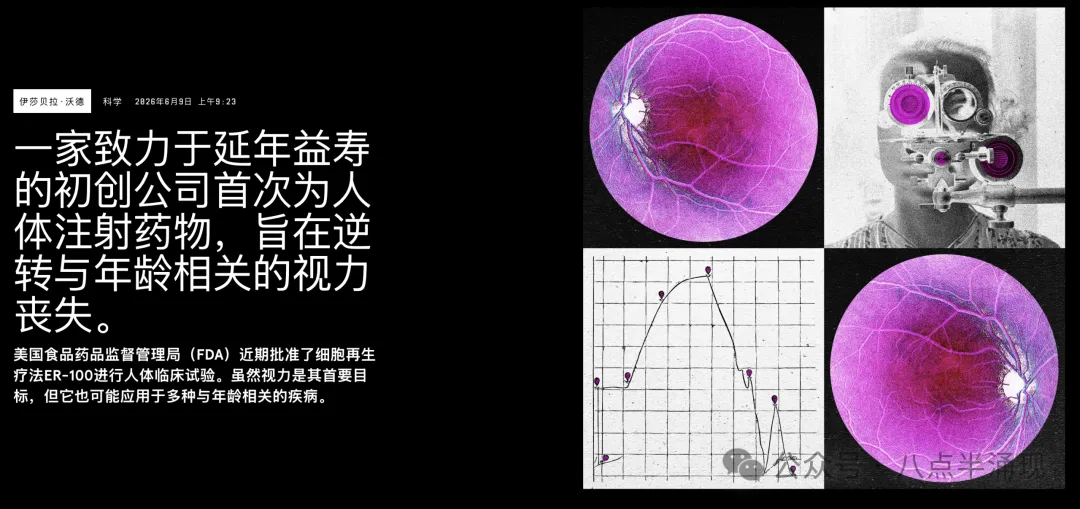
What if one day a doctor told you that aging is just a disease, curable with a pill—would you think they'd lost their mind? Yet in June 2026, something that sounds like science fiction has genuinely entered human clinical trials. For the first time, scientists have injected an epigenetic reprogramming therapy into a patient's eye.
It's not a cosmetic injection, nor a health supplement. It's an attempt to restore damaged optic nerve cells to their youthful working state. If this approach is ultimately proven safe, humanity's understanding of aging could be rewritten. Because aging may not simply be the body breaking down—it may be the body misreading its own life program.
Aging May Be About to Be Reversed
For the past few decades, the medical community has often understood aging as hardware wear and tear. You can think of the body as a car that's been driven for decades. Carbon builds up in the engine, wiring ages, parts loosen, and eventually the whole vehicle gradually fails. In the human body, this means DNA mutations accumulate, cellular damage piles up, and organ function declines. This explanation makes sense—as long as you're alive, cells must divide, and division can go wrong. UV radiation, inflammation, stress, and sleepless nights all leave their marks on the body.
But epigenetics proposes another, bolder idea. The body aging isn't necessarily just hardware failure—it could also be software corruption. Your DNA is like a complete set of blueprints, and nearly every cell holds the same copy. So why do some cells become corneas, some become livers, and some become neurons? The key isn't in the blueprints themselves, but in how they're read. Epigenetic information is like a backend operating system, responsible for telling cells which genes to turn on and which to turn off.
In youth, this system is clear and orderly. In old age, it begins to descend into chaos. Cells still hold the original blueprints, but they're increasingly unable to read them properly. If the problem lies in the reading method, then a truly frightening question arises: could we skip replacing parts and simply reboot the system?
Turning Cells Back to a Youthful State
Cells in a young body are like a group of well-trained employees. Skin cells know they need to repair the barrier, liver cells know they need to handle metabolism, immune cells know they need to clear abnormalities, and nerve cells know they need to maintain connections. But with age, this order begins to loosen. Stress, inflammation, UV radiation, alcohol, and high-sugar diets cause epigenetic markers in cells to continuously drift. It doesn't kill cells immediately—it slowly makes them lose their sense of direction.
Imagine an old factory: the machines are still there, the workers are still there, the blueprints are still there, but the instruction boards on the workshop floor are in disarray. Production lines that should be running haven't started, and dangerous switches that should be off have been accidentally triggered. So the same factory produces less and less output with more and more breakdowns. The aging of the body likely follows a similar process.
What epigenetic reprogramming aims to do is reset these instructions back to a youthful state. Let skin cells act like skin cells again, let nerve cells act like nerve cells again, let immune cells be as sharp as they were in youth. But there's a problem—it can spiral out of control.
Yamanaka Factors Opened the First Door
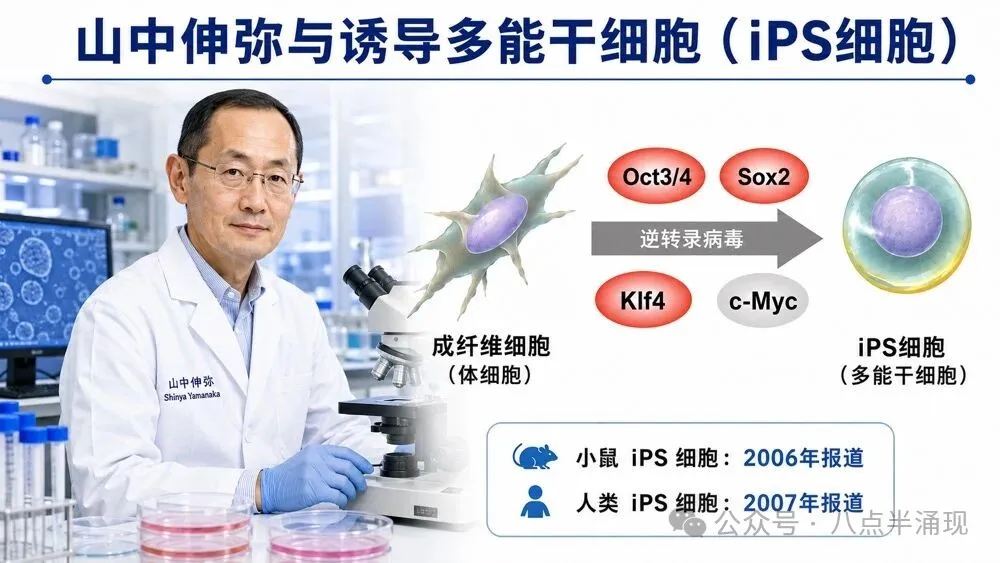
The person who truly gave the scientific community hope was Nobel Prize laureate in Physiology or Medicine Shinya Yamanaka. He discovered that by adding four special factors to adult cells, mature cells could be pulled back to a state resembling embryonic stem cells. This shook the life sciences world. Because it proved that adult cells are not completely locked in by fate. A cell that has already been determined can actually be reshuffled.
But this magic soon revealed its dangerous side. If cells are pulled back too far, they completely lose their identity. Skin cells no longer know they're skin cells, liver cells no longer know they're liver cells. A cell that has lost its identity, if it also gains powerful proliferative ability, will likely result not in youth, but in a tumor.
The cancer risk observed in early animal experiments forced scientists to hit the brakes. Rejuvenation is no fairy-tale fountain of youth—it's more like a race car without brakes. The real challenge isn't making cells younger, but making them just a little younger while always remembering who they are.
Scientists Proposed Partial Reprogramming
It doesn't pull cells all the way back to an embryonic state, but stops before cells completely lose their identity. It's like turning back time, but not all the way to infancy—only back to a younger stage with better function.
The eye therapy entering human clinical trials uses three factors—OSK—rather than the full four-factor combination. It avoids c-MYC, which more easily raises cancer concerns. Simply put, scientists removed the most dangerous accelerator and kept only the instructions that partially awaken the youthful state. The goal isn't to create stem cells, nor to make people rejuvenate overnight, but to help damaged optic nerve cells recover some of the gene expression patterns they had in youth. It's not about erasing the past, but helping cells rediscover their original operating manual.
But if the risks are so great, why was the first injection given in the eye?
Starting with the Eye Is About Absolute Safety
The eye is a relatively enclosed organ. After a drug is injected into the eye, its scope of action is fairly localized and won't rapidly spread throughout the body the way systemic administration would. For a new technology just entering the human body, local controllability matters more than ambition. You can think of the eye as an independent small room. Scientists first test whether the light can be turned back on in this room, rather than rewiring the entire building right away. The eye has another advantage: results are hard to fake.
The aspect of many anti-aging projects most easily questioned is that results are too subjective. Feeling more energetic, sleeping more deeply, skin looking brighter—these can all be easily packaged. But the eye is different. Which line on the eye chart you can read, whether your visual field has improved, whether the structure of the retina has changed—instruments can measure all of this clearly. So the eye has become the first testing ground for epigenetic reprogramming in humans. It's not the most ambitious target, but it's the most suitable organ for taking the first step.
But even so, scientists still don't dare let the program run unchecked. They need one more safeguard.
The Age-Reversal Program Must Be Interruptible at Any Time
To reduce risk, the research team designed a control switch for gene expression. Related reports mention that such systems can be regulated through drugs like doxycycline. Simply put, the program starts when you take the drug and stops when you stop. This design is crucial. Because the most terrifying aspect of reprogramming is losing control. If a cellular rejuvenation program is permanently switched on, no one knows what will happen long-term. It might repair damage, or it might push cells toward abnormal proliferation. Adding a switch is like giving a dangerous program a power cord. It can be started, observed, and shut down.
This is what truly makes this clinical trial worth watching. It doesn't prove that humans can already reverse aging—it proves that humans are beginning to learn how to control age reversal. If the switch in the eye can operate safely, the next question immediately arises: can the same logic be replicated in other organs?

Silicon Valley Sets Its Sights on the Liver
While the eye approach advances cautiously, another group of Silicon Valley players has already turned its gaze to the liver. The eye is suitable as a first testing ground, but the liver is more like the real big market. It's the body's largest metabolic factory, responsible for processing toxins, regulating energy, and it also possesses remarkable regenerative ability.
A young person's liver is like an efficient repair crew—even when damaged to some degree, it can recover quickly. But with age, this ability declines significantly. If aging liver cells could regain their youthful metabolic capacity, fatty liver disease, alcoholic liver damage, and metabolic disorders might all find new avenues of treatment.
That's why the new generation of anti-aging companies rarely say outright that they want to make people immortal. Instead, they say they want to treat optic nerve damage, treat fatty liver, treat a certain metabolic disease. As each organ is conquered one by one, the true picture will gradually emerge.
Artificial Intelligence Begins to Accelerate the Process
Traditional epigenetic reprogramming can't avoid the Yamanaka factors, but Silicon Valley-style companies have always been highly innovative. Their thinking is straightforward: there are thousands of transcription factors in nature, so why fixate on those few classic ones? Could there be safer, gentler new combinations less likely to trigger cancer?
So AI was brought into the biology lab. Models first predict which combinations might be effective, the lab then tests those combinations in real cells, and the results feed back into the model to make the next round of predictions more accurate. This process is a lot like the rapid testing done by internet companies—first generate candidate solutions, then use experimental data to eliminate and optimize. In the past, developing new drugs was like slowly searching for a needle in a haystack. Now it's more like having a machine first map out the most likely areas where the needle might be, then concentrating the search there.
But finding the code is only the first step. The real challenge is: how do you safely deliver this code into the human body?

Time May Become the New Luxury
Science is still in its early stages, but capital has already rushed in. The world's top billionaires and tech giants are turning longevity science into the most expensive gambling table. Some are betting on cellular reprogramming, some on AI drug discovery, some on organ rejuvenation, some on extending healthspan. Behind this isn't pure idealism—whoever can first extend healthspan could unlock a trillion-dollar market.
Healthcare systems, the elderly care industry, insurance pricing, and labor structures will all be recalculated. A person working an extra ten years in good health means a change in destiny for the individual and a change in productivity for society. But the problem is also glaring: at this stage, complex gene therapies are extremely costly. Viral vector production, quality control, clinical oversight, professional injection—every step carries a staggering price tag. If an organ rejuvenation therapy is approved in the future, it will very likely first become a high-end medical service available only to a few wealthy individuals.
In the past, the rich could buy better houses, better education, better doctors. In the future, they may also be able to buy younger organs and longer periods of health. At that point, the wealth gap won't just be written on bank cards—it will be written in biological age.

The Last Generation to Age Naturally
The significance of that injection in June 2026 lies not in declaring rejuvenation a success, but in pushing ideas that previously existed only in papers and animal experiments into the human body for the first time. Today, scientists start with the eye, because it's local, controllable, and yields clear results. Tomorrow, they may advance to the liver, because metabolism is critical there, regenerative capacity is strong, and it's also suitable for mRNA delivery. In the more distant future, skin, muscle, the immune system, and even the nervous system could all become new testing grounds.
Aging is transforming from a natural fate that must be accepted into a biological process that can be dissected, measured, and intervened upon.
For the first time, humanity isn't merely delaying death—it's attempting to read the code that time has written into the body. If one day in the future, healthy years can truly be priced, then what was once humanity's greatest equality—that everyone grows old—could become the greatest inequality. Because some will buy their ticket to agelessness first, while others can only continue to be pushed along by time.
So the ultimate question isn't whether humanity can defeat aging, but when this technology truly arrives, will it first save everyone, or first serve the wealthiest?
If time could truly be purchased, what price would you be willing to pay for an extra ten years of healthy life?