
Look up at the sky—do you think you're seeing a starry expanse? In truth, you're only witnessing 4% of the universe's existence. The remaining 96%, dark matter, is passing through your body by the ton, completely undetected. Our prized five senses are merely a "subjective filter" cobbled together from fewer than a thousand proteins. Bees see ultraviolet light, while goldfish see infrared. Humanity's so-called "seeing is believing" is likely just wishful thinking within a cognitive cage. How can we possibly break free from our known tools to touch the boundaries of the truly unknown?
Who Exactly Is That Tiny White Dot in the Panoramic View of the Universe?
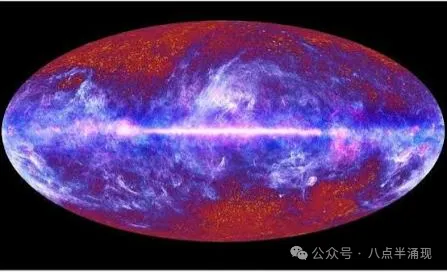 Don't think I'm being alarmist. This breathtaking photograph is the first panoramic image of the universe, officially released by the European Space Agency in 2010. A distinct white line stretches across the center of the image. If you start counting from the left edge, about a third of the way in, you'll spot an incredibly tiny, inconspicuous white dot. Look closely at it—that is our Milky Way galaxy, and the Earth thriving upon it.
Do you realize how suffocating the scale behind this is? In the entire observable universe, there are at least 200 billion massive galaxies like the Milky Way floating in space; and within each Milky Way, there are roughly 200 billion star systems similar to our solar system densely packed together. In this grand cosmic map, Earth's mass accounts for less than 0.005% of the solar system. How insignificant is that? It's almost negligible.
Yet, on this dust-like planet, humanity insists on standing here, trying to comprehend the vast laws of the universe with our limited lifespans, to deduce the distant future, and to relentlessly pursue artificial intelligence and life sciences. This grand narrative of an ant trying to measure an elephant is both romantic and cruel. It forces us to confront a core question: standing on such an infinitesimal coordinate point, using our existing rulers to measure the boundless darkness, can we truly touch the truth? The answer is often colder than our intuition suggests.
The Objective World We Think We Know Is Actually a Massive Illusion
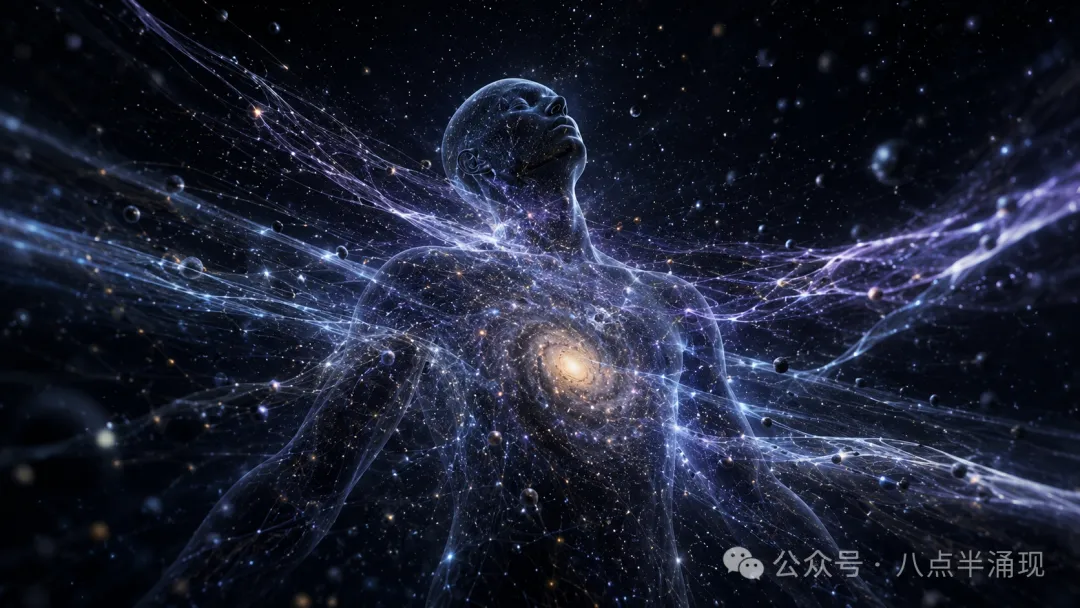
Many might frown at this point, or even suspect I'm being deliberately obscure: a non-objective world? It sounds like the ramblings of a philosopher. But let me lay out the hard-core physics facts for you. Everything you can see with your naked eye, touch with your hands, and all the forms of energy and matter you can distinctly perceive, added together, account for merely 4% of the universe's total existence.
Where did the remaining 96% go? You can't see it or feel it, but it objectively exists right there. Moreover, the vast majority of this 96% is in the form of energy, with up to 23% known as dark matter. This isn't a sci-fi movie setting; it's an observational fact universally recognized by the astronomical community. In just these few minutes while I'm speaking and you're quietly listening, massive tons of dark matter are passing unimpeded through your skull, spine, and limbs.
Find it unbelievable? Classical physics clearly tells us that two pieces of matter cannot occupy the same space simultaneously, so how does dark matter pass right through us? The reason is extremely simple: there is no strong interaction between dark matter and the human body, nor does it generate electromagnetic force; it only participates in the extremely weak weak interaction and negligible gravitational force. Once electromagnetic force is removed, all human perceptual systems would instantly and completely paralyze. That's right, from birth until now, all the sensory experiences we rely on are fundamentally and inextricably bound to the one-way street of electromagnetic interaction.
With Fewer Than a Thousand Proteins, How Can We Possibly Perceive the Vast Galaxy?
Let's completely dismantle the trump cards of the human perceptual machine. The olfactory system relies on about 400 odorant receptor proteins; touch depends on over 100 ion channels and GPCR proteins; and taste is barely supported by just a few dozen proteins. Pack these three basic senses together, and a mere 600 proteins take over most of our daily interactions.
Hearing is even more demanding, as it must rely on air as a medium to transmit sound waves. But how low is the average density of outer space? There is only one hydrogen atom floating per four cubic meters. In this near-absolute vacuum of deep space, sound simply cannot propagate, making human ears completely useless for interstellar travel. Therefore, our blind faith in "seeing is believing" is essentially just the passive reception of specific bands of electromagnetic waves by retinal cells.
But how narrow is this band? 390 to 700 nanometers. In this tiny sliver of the visible spectrum, X-rays are electromagnetic waves, gamma rays are electromagnetic waves, and radio waves are also electromagnetic waves, yet they are all invisible to humans. I'm certain there must be some special biological mutations or pathological conditions that could allow vision to break through this band limit. But this is precisely the tragedy of our biology—our hardware configuration is inherently shackled by heavy chains.
Hidden in the Eyes of Bees and Goldfish Are Truths Invisible to Humanity
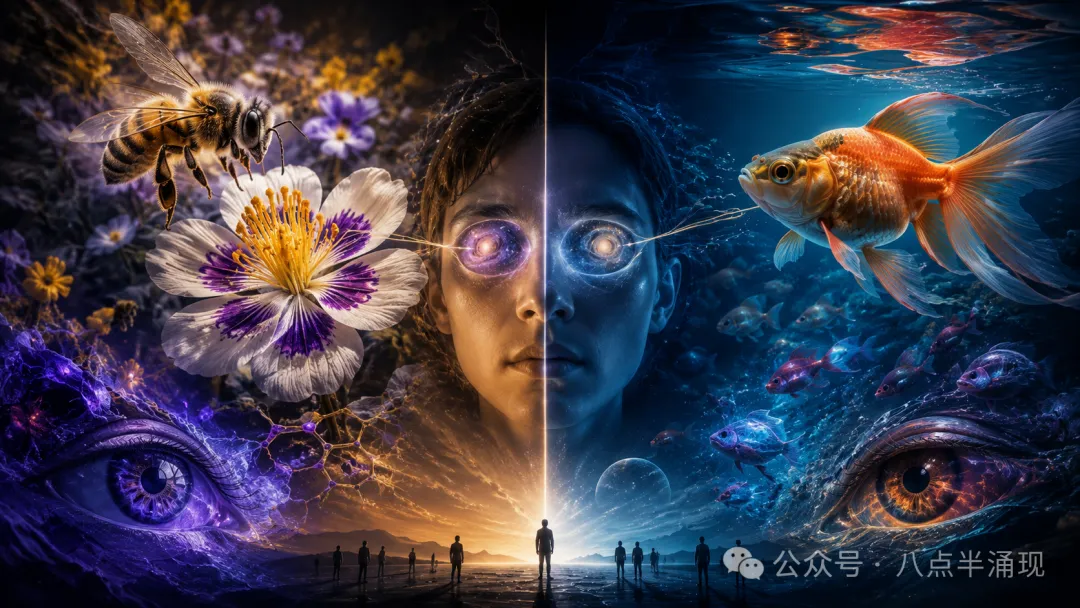
If you think humanity is limited enough, take a look at the vision of other species in nature. When bees are busy among the flowers, do you think they're admiring the colorful blooms? Completely wrong. They can't see colors in the visible light spectrum at all; they rely on near-ultraviolet light. To precisely attract pollinators, flowers have long evolved nectar guides that only appear under the ultraviolet spectrum.
Now look at the goldfish in an aquarium. Their visual range not only covers far-infrared but also catches glimpses of near-ultraviolet. The perceptual dimensions of these creatures exist in a parallel universe to ours, completely inaccessible to each other. This leads to a deeply unsettling philosophical question: can you guarantee that the red one person sees is exactly the same as the red another person sees? I can't prove it to you, and you can't prove it to me.
Since even the most basic color perception cannot be objectively aligned between individuals, how can the real world we constantly talk about possibly exist independently of the observer? The cognitive edifice we've built with fewer than a thousand proteins has had a subjective foundation from the very beginning. There is no god's-eye view, only one-sided observations through biologically tinted glasses.
Breaking Out of the Known Cage: Humanity's Next Tough Battle in Cognition
Since our sensory hardware is locked and our existing tools are confined to known frameworks, how should humanity break the deadlock? The frontiers of science have already provided clues. In highly hydrated special environments, triglycerides can catalyze the creation of the first known non-exogenous organic luminescent groups through chemical reactions. Conservative estimates predict that there are actually no fewer than a million such luminescent substances lurking on Earth's surface, yet we have currently identified and utilized fewer than ten.
Why do we always fail to discover new things? Because our inherent exploratory thinking is too narrow. We always think we're exploring the unknown, but in reality, we're just moving the unilluminated pieces on the chessboard of the known world. No matter how precise brain science gets or how explosive IT computing power becomes, as long as the underlying methodology still uses known means to detect unseen things within the known domain, we will forever be trapped in a slice of the information dimension.
The real challenge lies in this: how do we completely break free from the physiological limitations of these fewer than a thousand proteins? How do we develop entirely new perceptual media that can directly interface with dark matter and dark energy? Humanity's next civilizational leap is absolutely not about building telescopes with larger apertures, but about completing a fundamental reconstruction of our cognitive operating system. If we don't take this step, we are doomed to forever wander on the fringes of the universe, unable to glimpse its true deep waters.