
In the spring of 1912, the Titanic was about to set sail, but just before departure, one man suddenly did not board the ship. He was American financial titan John Pierpont Morgan. As an extremely influential capital figure behind the White Star Line, Morgan was originally deeply connected to this ship, yet he ultimately changed his itinerary at the last moment, miraculously avoiding what would later become a world-shocking maritime disaster. Days later, the Titanic struck an iceberg and sank into the North Atlantic. The frigid waters swallowed more than fifteen hundred lives, and Morgan's absence became a mystery that has endured for over a century.
Some say he was simply feeling unwell. Others say he had art business to attend to at the last minute. Still others believe that before certain disasters truly occur, the world has already shown some kind of omen—it's just that most people lack the ability to recognize it. In more bizarre rumors, the legendary inventor Nikola Tesla was also drawn into the story. Some claim that Tesla felt an unusual unease before the disaster and even tried to dissuade Morgan from boarding. This story has no reliable historical evidence to support it, but what's truly unsettling about it lies not in whether it's true or false, but in the deeper question it raises: Is human intuition merely an illusion of the brain, or some kind of reminder from an unknown information field?

Disasters Never Strike Without Warning
The reason the Titanic story has lingered for a century is not because Morgan's absence was particularly bizarre, but because it strikes at humanity's most ancient fear: before disaster strikes, is the world truly without any warning?
Before an avalanche truly erupts, tiny cracks have already formed deep within the mountain. Before an earthquake truly arrives, tectonic pressure has already been accumulating underground. Before a maritime disaster truly occurs, the route, weather, sea conditions, speed, human judgment, and technical blind spots have already woven together a dangerous trend in reality. Disasters may seem sudden, but they never appear out of nowhere. They are simply countless tiny variables reaching a critical point simultaneously at a single moment. Ordinary people only see the final collapse, but rarely notice the signals the real world has been quietly sending before the collapse.
So-called premonitions may not be people seeing the future in advance, but rather the brain capturing variables that ordinary consciousness overlooks in a fleeting instant. Those variables are too fine, too light, too fast—before they can be transformed into clear logic, they have already been compressed by the subconscious into a vague feeling: something isn't right.
Premonitions Are Not Seeing the Future
Many people have had similar experiences. You suddenly think of someone you haven't been in touch with for a long time, and the next second, their message appears on your phone. You walk into an unfamiliar place for the first time, yet you inexplicably feel you've been there before. You're about to make a decision, and rationally you can't find any problem with it, yet deep inside, a voice keeps reminding you: don't go, don't do it, stop.
We usually call these coincidences, illusions, sixth sense, or psychological suggestion. But what if they aren't random noise? What if these moments are actually the brain capturing information you're not consciously aware of? This is where the sixth sense is most easily misunderstood. It isn't necessarily directly foreseeing the future, nor is it sneaking a peek at the ending from some mysterious script. A more reasonable explanation is that it processes hidden clues in reality earlier than rational thought does.
It's like how a weather forecast doesn't actually see tomorrow's rain—it simply reads today's air pressure, humidity, wind direction, and cloud changes, then calculates a high-probability outcome based on countless similar patterns from the past. Human intuition may be something similar. It's not seeing the future, but receiving all the invisible variables of the present.
The Cosmic Memory Replay Hypothesis
If the universe is not a silent void but a super holographic hard drive that never shuts down, then everything we've experienced, every thought we've had, every choice we've made—could they all leave traces on some invisible level? This question sounds mystical, but one thing must be clarified first: if the universe possesses some kind of memory, what it records should be information that has already occurred, not a pre-written script of the future.
So-called cosmic memory doesn't mean the future already exists in its entirety, waiting for certain people to read it. It's more like a pattern library storing countless past events. What it records is not "what will definitely happen tomorrow," but "how countless similar events have unfolded in the past." So what you sense is not a spoiler of fate, but a deep-level pattern recognition. The event before you may have different people, a different place, a different time, but its underlying logic may have already played out countless times in the past.
The Past May Never Have Disappeared
Hungarian thinker Ervin Laszlo once proposed a highly impactful hypothesis: there may exist an information field in the universe similar to an "Akashic field." It doesn't have a physical shell like a hard drive, but may exist as a deeper energy structure, preserving traces of information from events that have occurred in the universe.
In this model, nothing in the world exists in isolation. Every movement, every collision, every birth and disappearance of life may leave some kind of trace deep in the universe. Like a stone dropped into a lake, ripples spread outward in all directions. After an event occurs, it may seem over on the surface, but the information ripples it triggered haven't truly disappeared. They've simply changed form, hidden in deeper frequencies. It's like a room filled with countless radio broadcasts simultaneously—you can't hear them, but that doesn't mean they don't exist. You can only hear one particular station because your receiver happens to be tuned to that frequency.
The Brain May Be a Receiver
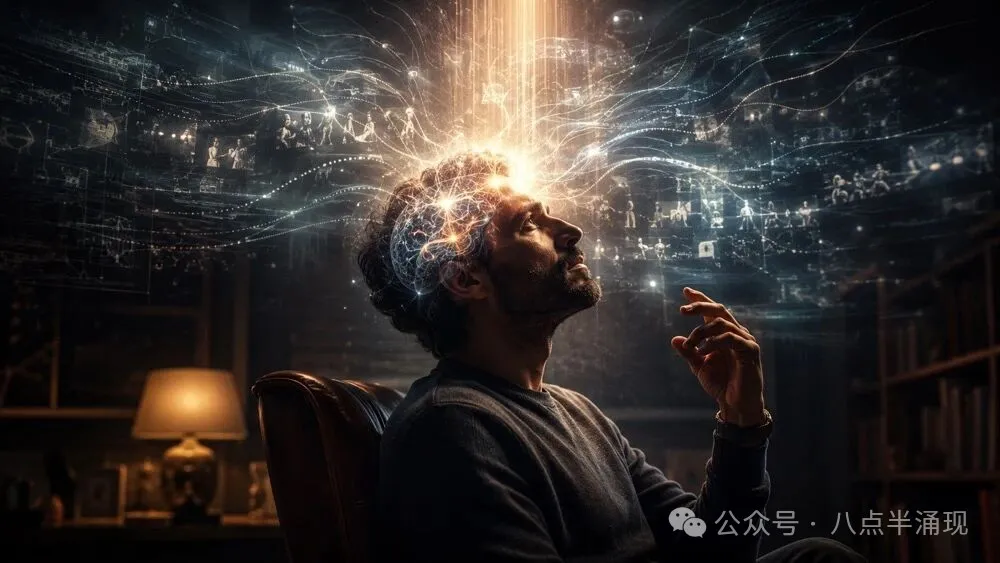
In traditional thinking, the brain is like a closed computer. External information enters through the eyes, ears, and skin, and the brain then analyzes, memorizes, and judges. But in some bolder theories of consciousness, the brain is not merely an information processor. It's more like a tuning device. It doesn't just generate consciousness internally—it may also, under certain special states, capture more hidden information from the external world. This sounds like science fiction, but the phenomenon of inspiration in real life is indeed very strange. Some scientists have received formulas in dreams, some musicians have heard melodies in a half-asleep state, and some writers have penned plots that years later bore astonishing similarities to reality. The most mysterious part is that many inspirations aren't arrived at through step-by-step reasoning—they appear suddenly and completely. It doesn't feel like thinking; it feels more like downloading.
But more accurately, it may not be downloading answers from the future, but rather the brain compressing fragments of the past, current clues, and subconscious patterns into a complete result in an extremely short time. So the answer suddenly appears—you don't know where it came from, but it's already in your mind.
Tesla's Mental Laboratory
Tesla himself once described an almost inconceivable method of creation. He wasn't accustomed to working like ordinary engineers—drawing plans first, then trial and error, then manufacturing. Instead, he would often construct machines directly in his mind, running them, spinning them, wearing them down, and even observing potential failure points. By the time he actually built the device, many details had already been tested countless times in his consciousness. It was as if he entered another laboratory inside his mind.
This is also why later generations would associate Tesla with a "cosmic information field." In those narratives tinged with mysticism, he wasn't an inventor in the ordinary sense, but rather someone who could tune his consciousness to a special frequency. His creations weren't just the results of calculation—they were also like fragments fished from some invisible ocean of information.
Of course, mainstream science doesn't readily accept such claims, because they're too difficult to verify. You can't prove someone truly received information from the future just because they had a premonition about something. Nor can you conclude that time can be read in advance by consciousness just because a dream later came true. The human brain itself is extremely skilled at finding patterns—we remember those "accurate" premonitions but forget the countless random thoughts that never materialized. But the point is, even if the sixth sense isn't some supernatural ability, that doesn't mean it's meaningless. Because it may indicate that the way the brain processes information is far deeper than we imagine.
The Subconscious Is Faster Than Reason
Today's neuroscience can record brainwaves, observe neuron firing, and determine which areas of the brain are more active when a person is tense, relaxed, focused, or afraid. Yet science still hasn't truly explained the most fundamental question: where does subjective experience come from? How can a mass of protein, fat, water, and electrical signals suddenly produce the sense of "I"? Why can you feel sadness, sense danger, experience inspiration, or even see places you've never been in your dreams?
If consciousness is merely a byproduct of neuronal computation, then intuition is the brain making rapid judgments based on past experience. For example, you enter a room and, though you're not consciously aware of anything unusual, your brain has already detected subtle changes in smell, light, expressions, and sounds, and issues an early warning. This is a very reasonable explanation. But if consciousness is not merely a product of the brain's interior, but a local manifestation within some larger information system, then intuition may not be simple "guessing," but a more complex form of information reading.
What it reads is not the future, but patterns left by the past. What it perceives is not fate, but trends that are currently approaching. Between these two explanations lies an entire universe.
Signals Emerge Only in Stillness
Meditation, dreams, deep focus, and moments of near-danger are often considered the times when consciousness is most likely to enter unusual states. In these states, the five senses' attention to the outside world decreases, and the brain's internal noise may also change. As a result, signals that are normally drowned out have a chance to surface. It's like how during the day, the city is too noisy for you to hear a distant bell. Late at night, when everything grows quiet, that faint vibration finally travels through the air and reaches your eardrum.
Could so-called premonitions work the same way? It's not the universe suddenly speaking to you, but the world has always been sending signals—you're just too noisy normally to hear them. When you quiet down, the surface noise of the brain decreases, and the subconscious becomes like an antenna raised anew, beginning to capture overlooked details. A facial expression, a pause, a scent, an illogical environmental change, a faint signal before danger approaches—individually, none of these are obvious, but when they're combined deep in the brain, they become an indescribable feeling: be careful.

Patterns Repeat Again and Again
If the universe truly possesses some kind of information memory, then the most unsettling thing about it is not that it helps people foresee the future, but that it may preserve the evolutionary patterns of all past events. How every disaster formed, how every civilization collapsed, how every life was born, how every choice altered the outcome—if these patterns have never truly disappeared, then the so-called sixth sense may be the brain briefly overlapping with these patterns under extremely special states. What you encounter is not the future, but a structure that has already occurred countless times in the past. The event before you has simply changed its people, its place, its time, but the underlying logic is strikingly similar.
So you suddenly feel familiarity, suddenly feel unease, suddenly feel that something is sliding in a certain direction. That's not because the future has already been written, but because patterns from the past are reappearing in reality. This is the more reasonable connection between cosmic memory and the sixth sense. Cosmic memory preserves patterns, the brain captures signals, the subconscious matches at high speed, and intuition pushes the result in front of you.
Reality May Just Be an Interface
Humanity's understanding of reality may have always been like looking through frosted glass. We think we're seeing the complete world, but in fact we're only seeing the version translated by the brain. Sound, color, time, space—all are results processed by the nervous system. What the real universe itself looks like, we have never directly seen. We simply live inside an interface created by our senses. Just as a folder icon on a computer screen doesn't equal the actual data structure on the hard drive—the icon is merely a visual symbol for your convenience. Perhaps the reality we see is also just an interface generated by the universe to allow consciousness to operate within the world.
And so-called intuition is an occasional crack in this interface. The crack is brief, so brief it lasts only an instant. Before you can explain it, it's gone. But in that instant, you seem to know something. You don't know why you know it, but you just know.
Humans Only Hear a Few Channels
Animals become abnormally restless before earthquakes, migratory birds can cross thousands of miles to return to their homeland, and whales can receive signals from distant members of their species in the deep ocean. Nature is never short of perceptual systems we cannot comprehend. Humans are simply accustomed to labeling everything they can't hear, see, or measure as nonexistent. But the universe doesn't contain only one species—it's more like an interconnected system of all things.
Different life forms receive different channels; different senses translate different realities. What we call the normal world may simply be the version our human sensory equipment allows us to see. So the most fascinating thing about the sixth sense is not whether it can foresee the future, but that it reminds us: the reality humans can perceive may be far from the entirety of reality.
Intuition May Be Reality's Critical Reminder to You
Perhaps one day in the future, consciousness science will truly develop new testing tools. We may be able to more precisely observe the brain during meditation, study changes in the nervous system before bursts of inspiration, and analyze whether the body captures certain faint signals in advance when making intuitive judgments.
By then, the ancient and ambiguous term "sixth sense" may be broken down into clearer scientific mechanisms. Part of it comes from experience, part from the subconscious, part from the body's subtle perception of the environment, and another part may truly come from an information field we have yet to understand.
If the universe is truly a holographic hard drive, then death, forgetting, and the passage of time may not be complete deletions, but merely changes in access permissions. Our inability to access something doesn't mean the data doesn't exist. Our inability to hear something doesn't mean the channel is silent. But this doesn't mean the future has been completely written. More likely, all the patterns left by the past are continuously shaping the present, and every tiny change in the present is quietly pointing toward the future.
So-called intuition is the brain compressing the past, present, and trends together in an extremely brief instant, handing you an answer you haven't yet had time to explain. The next time you suddenly feel uneasy, suddenly think of someone, or suddenly receive an answer in a moment without any warning, don't rush to toss it into the "coincidence" trash bin. Perhaps it's just the brain's misjudgment, perhaps it's just the subconscious reminding you. But perhaps, in that single brief second, you truly heard an echo from the depths of reality.
It's not a spoiler of the future, but a pattern from the past reminding you: something may be about to happen.