
What if death is not the end, but a dimensional shift?
This question sounds like mysticism, yet it subtly touches upon humanity's deepest fear: when the heartbeat stops, the brain shuts down, and the body begins to decay, where does that thing which once could think, feel, and say "I" actually go?
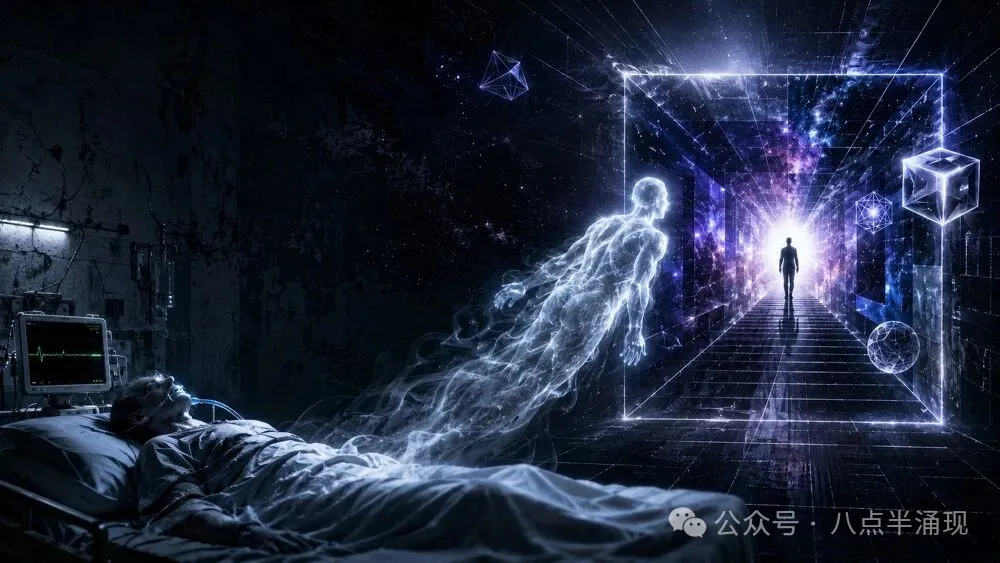
I. Could Death Not Be the End?
Religion says it goes to another world, philosophy says it returns to nothingness, and medicine says consciousness is merely a product of neural activity in the brain—once the brain stops functioning, the "I" vanishes with it.
But there is an even stranger possibility: what if death is not about leaving the world, but about leaving the three-dimensional slice we are familiar with? If two-dimensional beings can never comprehend three dimensions, on what basis can three-dimensional humans assert that there is no higher direction beyond death?
Perhaps so-called death is neither the soul soaring into the sky nor consciousness plunging into darkness, but rather, after our bodies—trapped in length, width, and height—cease to function, the question of "I" collides with the fourth dimension for the first time.
If dimensions are more than just mathematical symbols, if space truly contains directions that humans cannot perceive, then could death simply be a "departure" that we can no longer observe?
II. "Death" Through the Eyes of Two-Dimensional Beings
To understand this question, let us not rush to talk about humans, but instead imagine a world with only two dimensions. It is like an infinitely extending sheet of paper, where life on the paper can move forward, backward, left, and right, build houses, develop civilizations, and even contemplate death—but they will never know that there is a direction called "height." Now, suppose a two-dimensional figure lies on the paper, its body a shape enclosed by lines. In the two-dimensional world, this body is complete, closed, and genuinely existent. Its friends can see it, and it can feel its own boundaries. At this point, a three-dimensional human reaches out and gently "lifts" it from above the paper. From our perspective, this is a very simple action, but for the other beings in the two-dimensional world, the most terrifying thing happens: that figure suddenly vanishes from the world—no explosion, no corpse, no trace—it simply disappears into thin air.
How would scientists in the two-dimensional world explain this? They might say that this person has died. Because in their world, life no longer appears, information no longer returns, and the body can no longer be observed. By the standards of the two-dimensional world, it has indeed "died." But from a three-dimensional perspective, we know the truth is entirely different—it has not disappeared; it has merely left the paper.
This is the most fascinating aspect of dimensional imagination: a "death" or "disappearance" in a lower-dimensional world may, from a higher-dimensional perspective, simply be a change in position. For two-dimensional beings, leaving the paper surface is an incomprehensible endpoint; for a three-dimensional observer, it is merely a shift in direction.
So here is the question: if we humans are also a kind of "three-dimensional slice life," could death be something similar?
III. The Life We See May Only Be a Cross-Section
The reason we consider a person "alive" is that we can see their body functioning in three-dimensional space. The heart beats, blood flows, nerves transmit signals, and the brain generates consciousness. As long as these processes continue, we say this person is still alive. But this is only a definition from a three-dimensional perspective—just as two-dimensional beings can only see the circle formed when a three-dimensional finger passes through the paper surface. Could our souls also be projections of some higher-dimensional existence in the three-dimensional world?
This idea sounds very bold, but it is not meant to prove the existence of the soul, nor to prove that people definitely go somewhere after death. The real question it raises is: could our understanding of life be limited by our observational dimensions? We see a person being born, like a higher-dimensional object intersecting with the three-dimensional world for the first time; we see a person growing up, like this cross-section constantly changing; we see a person dying, like this cross-section finally leaving our world.
In this analogy, death is not "nothingness" but "invisibility." This does not conflict with death in the medical sense. Medicine studies how the three-dimensional body ceases to function, how the heartbeat terminates, and how the brain loses activity. These are all real, serious, and detectable processes. The point is that medicine can describe the termination of the body, but it struggles to answer that more ancient question: why does subjective consciousness arise? Why does "I" awaken in this particular body? When the brain stops, does the experience of "I" completely vanish, or does it transform into some state we cannot describe?
IV. If the Fourth Dimension Exists, Would It Be Like Heaven?
Many people, upon hearing "entering the fourth dimension after death," immediately think of heaven, souls, and the afterlife. But from the perspective of scientific imagination, the fourth dimension is not equivalent to heaven. The fourth dimension in mathematics is usually just an additional spatial direction. It has no good or evil, no judgment, and does not guarantee the existence of consciousness. Just as three-dimensional space is immensely mysterious to two-dimensional beings, three-dimensional space itself is not a divine realm—it simply has one more direction that two-dimensional beings cannot move in.
If a fourth spatial direction truly exists, it may not be gentle, and might even be completely unsuitable for three-dimensional life. Every structure in our bodies depends on three-dimensional space: the wrapping of cell membranes, the folding of proteins, the helix of DNA, the positional relationships of organs—all are built upon the rules of length, width, and height. Once we truly enter an additional spatial direction, we might not gain freedom but instead be utterly unable to maintain our current form.
Therefore, entering the fourth dimension after death does not necessarily mean the ascension of the soul. It is more like an unsettling conjecture: perhaps what we call existence is merely a projection in a higher-dimensional world; perhaps what we call death is simply the end of this projection in three-dimensional space. This is colder than heaven and stranger than nothingness. Because it does not give you an answer—it only makes the question bigger.
If humans are merely slices in a three-dimensional world, where is the complete "person"? If our entire lives are just the trajectory left by some higher-dimensional structure passing through three-dimensional space, could birth, growth, and death in time merely be illusions caused by our low-dimensional perspective?
Just like a finger passing through a two-dimensional plane, two-dimensional beings see a circle being born, growing larger, shrinking, and dying. But from the three-dimensional world, that finger has never truly been "born" or "died." It simply passed through the paper.
So, could our entire lives be the same?
V. Consciousness Is the Most Higher-Dimensional Thing
Among all human experiences, the thing least like a three-dimensional object is consciousness. Your body has weight, position, and shape. Your brain can be scanned, nerves can be detected, and blood can be tested. But the very fact of "I am experiencing" cannot be directly seen by others. Others can see your expressions, hear your words, and measure your brainwaves, but they can never directly enter your subjective world. The red you see, the sounds you hear, the fear and love you feel—these are forever separated from others by a wall. This is the most mysterious aspect of consciousness.
It clearly depends on the brain, yet it cannot be placed on a table like a piece of meat. It is like some kind of "inner perspective" that emerges from three-dimensional material activity. Science can study how the brain works with increasing precision, but regarding why subjective experience arises, there is still no answer that satisfies everyone.
This is also why questions like "do we enter the fourth dimension after death" keep recurring. It is not because humans are ignorant, but because death and consciousness themselves leave enormous blanks.
What people truly want to ask is not: where does the corpse go? That answer is clear. The corpse decomposes, returns to the natural cycle, and becomes part of other matter. What people truly want to ask is: where did the "I" that once sat inside the body looking at the world go? If "I" is merely a phenomenon produced when the brain is running, then death is complete extinction. If consciousness exists on some level we have yet to understand, then death may not be a simple ending.
VI. The Most Terrifying Thing Is Not Death, but Not Knowing Which Layer We Are On
Perhaps humans do not enter the fourth dimension after death. Perhaps consciousness truly disappears when the brain stops, like a lamp being extinguished—the world remains, but "I" no longer exist. This is currently the most scientifically cautious position.
But the thought experiment of four-dimensional space still has value. It is not meant to prove the afterlife, but to remind us that human intuition is unreliable. If two-dimensional beings have never seen height, they will treat the paper surface as the entire universe. They cannot imagine that above their heads there is actually a complete world. Similarly, living in three-dimensional space, we easily treat three dimensions as the ultimate form of reality. Yet history has repeatedly shown us that human senses often deceive us.
We once thought the earth was still, then discovered it rotates. We once thought the sky was just a dome, then discovered the universe is terrifyingly deep. We once thought what our eyes see is everything, then discovered that visible light is only an extremely narrow band of the electromagnetic spectrum.
So when we say "death is the absolute end," is this statement a scientific conclusion, or a judgment made by three-dimensional beings based on limited senses? The answer is not simple.
Science will not easily promise an afterlife, but science will not declare that the universe has no deeper structure simply because humans cannot imagine it. The truly rational attitude is neither to credulously believe that souls enter the fourth dimension nor to crudely mock all contemplation of death, but to acknowledge: we know a lot, but we are far from knowing everything.
VII. Perhaps We Are Merely a Slice of the Universe
If one day humanity truly discovers extra dimensions, the question of death may be reinterpreted. But even when that day comes, it may not bring the answers we imagine. The fourth dimension may not give us heaven, nor give us immortality. It may simply tell us: reality is stranger than human intuition.
A two-dimensional being can never imagine the complete form of a three-dimensional person—it can only see slices. A three-dimensional human may likewise be unable to imagine the complete structure of a higher-dimensional world. We see birth, so we think it is the beginning; we see death, so we think it is the end. But from a higher perspective, could all of this merely be traces left by some complex structure passing through time and space?
Do humans enter the fourth dimension after death? Science's current answer is: there is no evidence.
But the true value of this question is not to find a comforting answer to death, but to force us to rethink our own position.
We think we live in a complete world, but perhaps we only live on a thin slice of reality. We think death is disappearance, but perhaps it is only because we cannot see what happens beyond the slice. We think three dimensions are everything, but perhaps it is only because we have never had the ability to turn toward the fourth direction.
So perhaps the deepest mystery of death is not "where do people go after death," but: while alive, do we truly know where we are?