
If you were to remove every planet, star, dust particle, and even all life from the universe, what would remain? The answer seems simple: absolute nothingness. No light, no sound, nothing at all exists—that is the vacuum as we understand it.
Yet if you were to journey into the deepest voids of the cosmos, what awaits you may not be deathly silence, but an unimaginable spectacle. Modern physics reveals that the emptiest regions of the universe may precisely conceal its most formidable energy. What we call "nothingness" may merely be an illusion conjured by human perception. On scales beyond our sight, space itself is in constant fluctuation, saturated with countless quantum fields that possess no form, no hue, and elude direct detection.
Yet they constitute everything we see. Planets, life, and even your consciousness all originate from these fundamental structures hidden behind the vacuum.
All Things Arise from the Void
In human understanding over the past few millennia, "emptiness" meant nonexistence. An empty room contained nothing. A container with the air pumped out was considered close to a vacuum; space was merely a vessel waiting to be filled with matter. This perspective dominated for a long time until the advent of quantum mechanics. Scientists discovered that the universe is not a machine composed of countless tiny parts. In the microscopic world, particles are not the most fundamental entities. Electrons do not float like tiny stones, nor are photons little glowing spheres. Instead, they resemble fields hidden throughout the cosmos, manifesting as phenomena when excited in certain ways.
Like ocean waves, what you see is the crest, but the wave itself is not an independently existing entity; it is merely a manifestation of the ocean. Similarly, the entire material world we observe may simply be a "ripple" generated by the underlying structure of the universe.
This is where the quantum world becomes most bizarre: even if all particles were removed, space would not become absolutely blank. Because quantum fields always exist, what we call a vacuum is merely these fields in their lowest energy state. It is not death, but more akin to slumber—calm on the surface, yet concealing unimaginable possibilities within.
Like a frozen ocean that appears completely still, as long as sufficient energy is introduced, the power hidden beneath the ice will be unleashed. Scientists have long wondered: if we apply a sufficiently intense stimulus to the vacuum, will it awaken what lies dormant within? Could it cause particles that previously did not exist to materialize directly in reality?
A Cosmic-Scale Collision Experiment
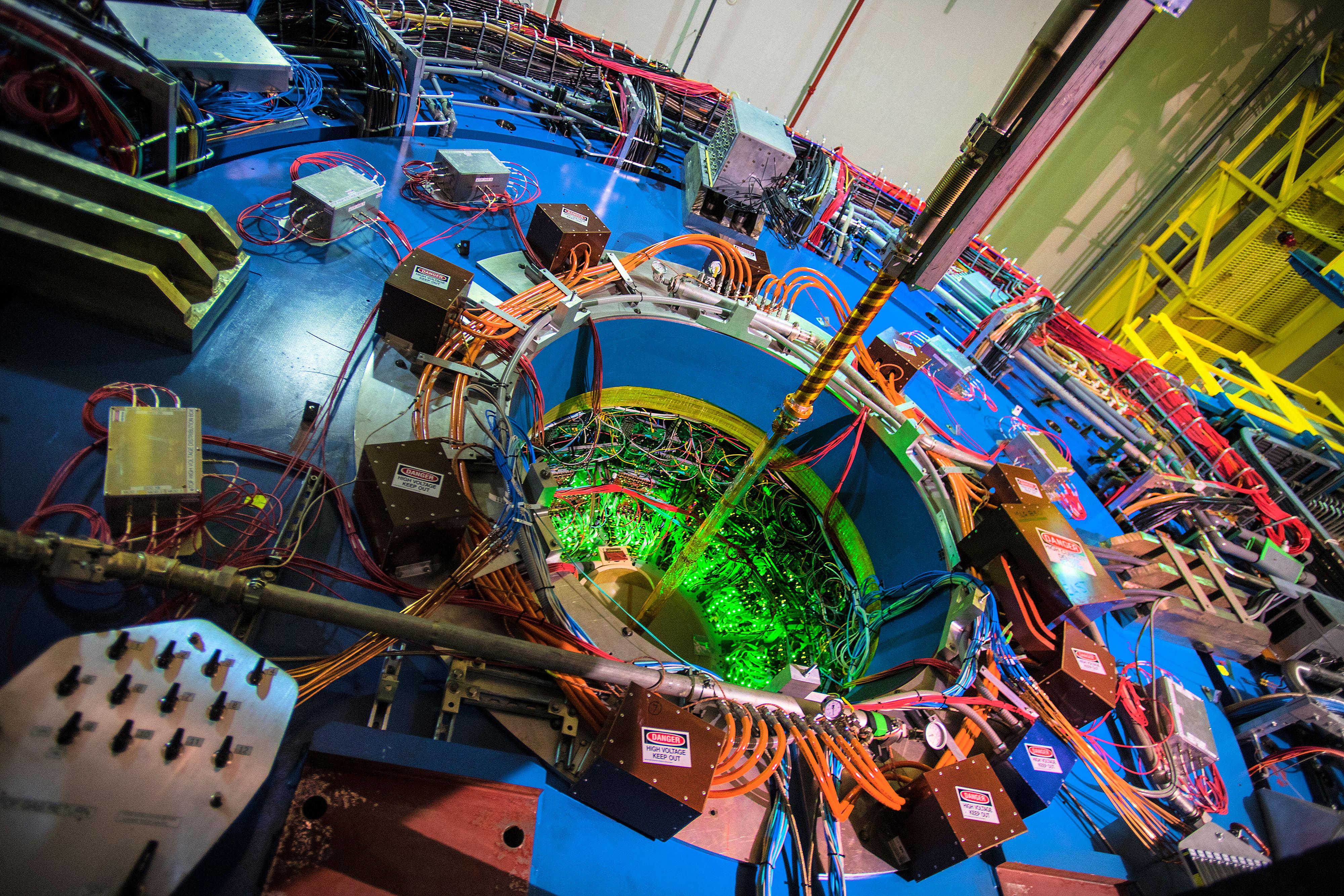
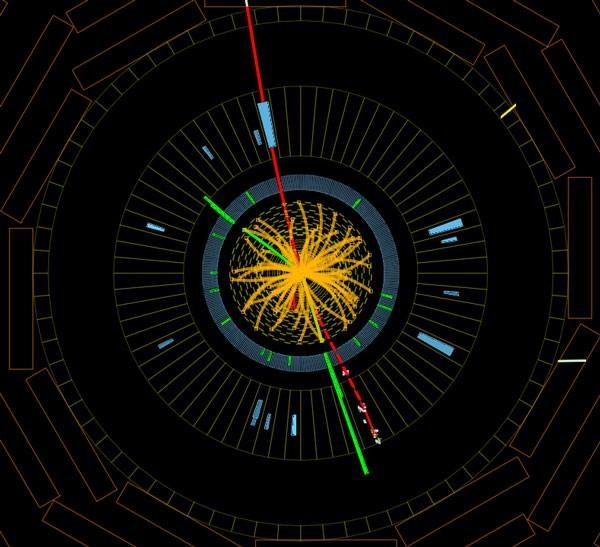
At the Brookhaven National Laboratory in the United States, scientists conducted a particle collision experiment using one of the world’s premier relativistic heavy-ion colliders. Particles were accelerated to near light-speed and made to collide instantaneously, generating an extreme physical environment unseen elsewhere in the cosmos. In that fleeting moment, energy density soared to unimaginable heights. Detectors promptly registered anomalous signals: tracks of particles that had not existed before suddenly materialized in the collision zone like ghosts. They surged violently through magnetic fields, leaving precise data trails on the recording devices.
This experiment unveiled an extraordinarily strange phenomenon: under certain conditions, energy can indeed transmute into physically existing matter.
In 1905, Einstein proposed E=mc². With just a few simple characters, it tells us that mass and energy are fundamentally indistinguishable. A rock, a star, or a human body are essentially different arrangements of energy. Historically, this formula seemed more like a theoretical principle, but today, we can already witness part of its true manifestation in laboratories. When extreme energy environments arise, the universe can rearrange its own composition. Energy becomes particles, particles form matter, and matter ultimately constitutes everything we see.
This implies that matter is not the primordial substance of the universe; it may merely be the result of energy arranged according to certain rules.
The Universe's Underlying Code
The truly staggering aspect of this experiment is not the creation of a few particles. Rather, it forces us to reconsider: Is the world we see truly the "fundamental reality"? In the past, we believed tables were real, bodies were real, and planets were real. But modern physics is telling us that these things may merely be appearances of a deeper structure. Like an image on a computer screen, you perceive a complete world, but behind the screen, what actually runs is program code. Perhaps the universe operates similarly: we see particles, but what supports them are the quantum fields lurking behind the scenes. Could those quantum fields possibly be that underlying code?
13.8 billion years ago, when the universe was first born, there were no galaxies, no sun, no Earth, and certainly no humans. The entire cosmos existed in an extremely high-energy state. As the universe continuously expanded and cooled, energy began to transform, giving rise to fundamental particles, then atoms, followed by burning stars and the birth of elements. Eventually, after eons of evolution, these simple particles assembled into complex life. Then, one day, some of this matter began to ponder: "Where exactly do I come from?" Thus, through life, the universe started to turn inward and comprehend itself.
The carbon in your body originates from the interiors of stars, and your oxygen comes from ancient stellar explosions. Every atom that makes up your physique has endured the cosmos' long evolution. You are not standing outside the universe observing it; you are an integral part of it.
Can Energy Transform into Any Matter?
Thousands of years ago, humanity gazed up at the starry sky, questioning the origins of all things. Some believed heaven and earth were created by gods, while others thought everything stemmed from "the void." Today, we still do not know why the universe exists, why it is not eternal darkness, why it is not absolute nothingness, why matter appeared, why matter gave rise to life, and why life ultimately produced consciousness.
But quantum experiments are gradually revealing a startling direction: the foundation of the universe may not be a blank slate at all. What we call "nothingness" might simply be a state we have yet to comprehend, and what we deem "nonexistence" could merely be another form of existence.
In other words, even in the seemingly empty space right before your eyes, a majestic force capable of reshaping stars surges ceaselessly.