
This is not alarmist. Think carefully: after closing your eyes every night, do you still remember how you fell asleep? You have no way of recalling what happened in that instant—because the moment you fall asleep, consciousness is suddenly extinguished, the "self" completely dissipates, and that emptiness is exactly like death.
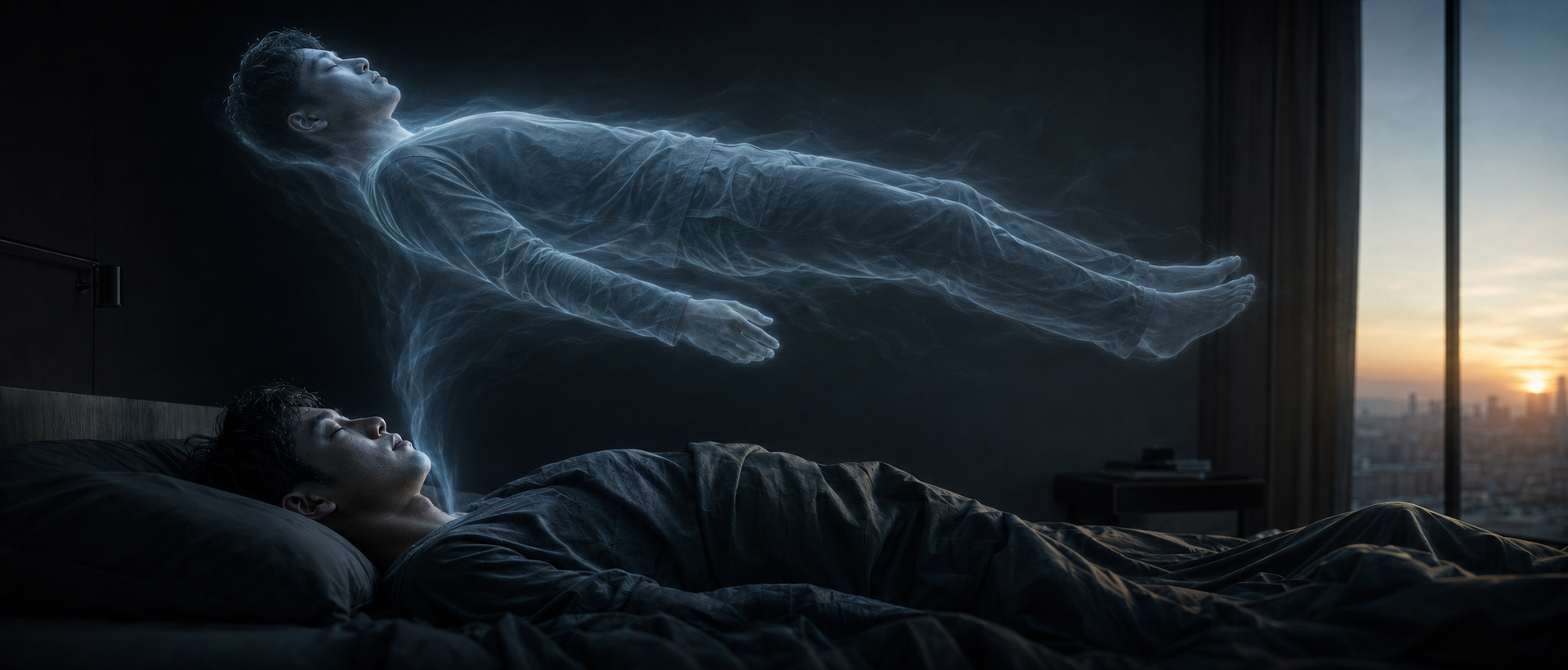
A research team at the University of Wisconsin once recorded a disturbing phenomenon: when we enter deep sleep, the connections between various regions of the brain are completely severed. Self-consciousness doesn't just blur; it drops straight to zero. This is the moment our consciousness comes closest to disappearing, short of clinical death. During those missing hours, where exactly does "you" go? And when you wake up the next morning, who is it that continues to recognize yourself and remember yesterday's events?
During Deep Sleep, You Are Already an Empty Shell
Many people think sleeping is just a matter of closing and opening your eyes, but in reality, as you enter sleep, your consciousness is dismantled layer by layer until it completely vanishes.
Step One: Sleep Onset, Brain Self-Checks and Hypnagogic Hallucinations
In the first ten minutes of lying down, brainwaves begin to slow, and the body relaxes. A common phenomenon often occurs at this time: just as you are about to fall asleep, your body suddenly jerks violently, sometimes accompanied by a dream of "stepping into empty air and falling." This isn't a calcium deficiency, nor is it an omen—it's the brain misjudging the situation as "dying" and quickly sounding the alarm to pull you back.
At the same time, the brain secretly broadcasts a "hypnagogic hallucination"—in the twilight state between sleep and wakefulness, you might suddenly "see" a shadowy figure, "hear" someone calling your name, or feel something touch your hand. These images and sounds are as clear as reality, but they are neither dreams nor reality; they are simply the brain briefly playing the wrong reel while switching systems.
Step Two: Light Sleep, Organizing Memories and Clearing Fragments
First, surface consciousness begins to blur. If someone calls your name, you might still respond, but you can no longer remember what you were just thinking about. The brain isn't idle at this point; it releases electrical activity called sleep spindles, specifically responsible for organizing the day's memories. Important ones are sealed and stored in long-term memory, while trivial ones—like what you had for lunch—are directly cleared. The reason you can still recognize who you are the next morning relies entirely on this step.
Step Three: Deep Sleep, Consciousness Detachment, and Waste Clearance
Occurring roughly twenty to sixty minutes after falling asleep, brainwaves slow to less than one per second, and self-awareness completely disappears. At this point, let alone calling your name, even a gentle touch won't elicit any response from the brain. This is the lowest point self-awareness can drop to outside of a waking state.
Meanwhile, the brain initiates a major cleanup: clearing out the "neural waste" produced by daytime metabolism. For those who chronically sleep poorly, this waste isn't fully cleared, and over time, it will erode memory and cognitive function, increasing the risk of Alzheimer's disease.
Step Four: REM Sleep (Rapid Eye Movement), Consciousness Reboot
Appearing about an hour after falling asleep, the brain's activity level at this stage is almost identical to when you are awake—but your entire body's muscles are completely locked, unable to move even a finger. This is the body's self-protection mechanism: it prevents you from physically acting out your dreams, otherwise, many people would jump out of bed in their sleep.
Consciousness comes back "online" at this moment, but it is no longer the familiar daytime self you know.
Sleep Paralysis is Actually the Separation of Consciousness and Body
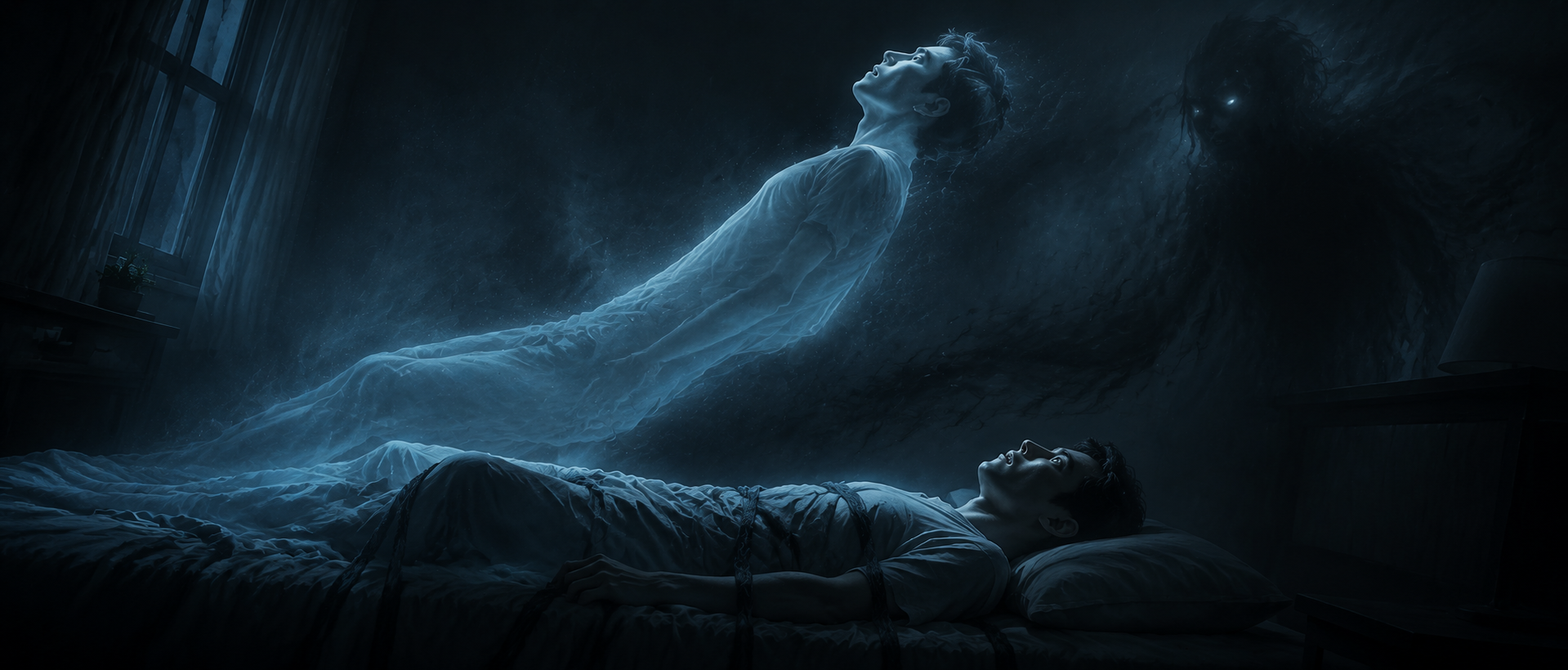
Many people have had this experience: waking up suddenly in the middle of the night, able to open their eyes but unable to move a single finger or make a sound from their throat, while clearly feeling something pressing down on them in the room, or standing motionless by the bed staring at them. The older generation calls this "ghost pressing on the bed."
It is not a paranormal event, but a disconnect between the body and consciousness. The mechanism that locks the body's muscles during REM sleep, which should be released along with consciousness, is half a beat too slow this time—the brain comes back online first, but the body's lock hasn't been opened yet. A safety device meant to protect you from acting out your dreams has, this time, locked you inside.
Even more bizarrely, this state is often accompanied by intense hallucinations: feeling someone break into the room, something pressing on your chest, or hearing footsteps or whispers. These are not supernatural phenomena; they are dreams that haven't yet exited the stage, superimposed directly onto your already waking senses.
What is truly unsettling about this is not the "inability to move," but that it tears open a fact usually perfectly concealed: you assume "waking up" is an instantaneous, holistic switch—body, consciousness, and senses all coming back online simultaneously, seamlessly. Sleep paralysis tells you that it is never a single instant, but rather several independent systems waking up on their own. It's just that most of the time, they happen to synchronize so perfectly that you never suspect you are "pieced together."
Once they fail to align, the body and consciousness act independently, which may be the origin of out-of-body experiences.
Communication Between Dreams and Reality
Why are dreams always logically chaotic and wildly imaginative? Why can you fly in a dream or talk to deceased people without finding it strange at all? Because during the REM sleep stage, the prefrontal cortex, responsible for rational judgment, is almost entirely offline. The social masks you maintain during the day, the moral constraints you follow, and that entire set of logical judgments in your head all lose their binding power.
What runs out to direct this show is the more primitive, less polished part of yourself in the subconscious. The things that frighten you in dreams are often the very vulnerabilities you refuse to face when awake; the desires that surface in dreams may be the obsessions you dare not admit during the day.
Even more interesting is "lucid dreaming"—something many have experienced, where you suddenly realize "I am dreaming" and then begin to actively control the dream. This was once dismissed as subjective hallucination, until German researchers conducted an experiment: they agreed in advance with subjects capable of lucid dreaming that once they realized they were dreaming, they would move their eyes in a specific trajectory to transmit a Morse code-like signal.
The experiment actually succeeded. While truly dreaming and in the muscle-locked state of REM sleep, the subjects completed two-way communication with the waking researchers through eye movements. This proves that the consciousness in a dream is not an illusion in the void, but another state of consciousness genuinely produced by the brain, just operating under completely different rules.
Why Are You Reborn Every Day?
The part of consciousness that disappears during deep sleep does not truly perish; it merely switches its form of existence: it goes dormant during deep sleep to let the body and brain repair; it flows freely during REM, releasing your repressed parts; and when lucid dreaming occurs, the consciousness of both reality and dreams can even hang on you simultaneously.
Some neuroscientists have proposed a theory: the so-called "I" is actually a self temporarily pieced together by the brain using past memories the moment you wake up. For the vast majority of people, the result pieced together every day is highly similar, which is why you take it for granted that "today's me" is "yesterday's me." But about 3% of people will wake up one day to find their original personality is completely gone. There is nothing physically wrong with their body, they eat and sleep as usual, yet they cannot recognize their family and friends, insisting they are someone else. Medically, this is known as depersonalization.
This forces a terrifying question upon deep reflection: if consciousness undergoes a reset and reconstruction every single day, what makes you so sure that the person who climbs out of bed today is the same one who lay down last night?
Every time you open your eyes each day, it is actually a rebirth—you just don't know it!