
Imagine a scene: you pick up a piece of braised pork belly, marbled with fat and lean meat, with clear grain. The aroma of melting fat and the texture upon chewing are identical to the pork flavor in your memory. But this meat never belonged to any living pig; it never grew inside a pig's body. Would you dare to eat such pork?
To date, five countries and eleven companies worldwide have officially approved the legal market launch of this "cultured meat." From sampling to serving on the table, the entire process takes less than a month, without a single pig being slaughtered. An unsettling question arises: when meat can be manufactured independently of an animal's body, does all our understanding of "eating meat" need to be completely overturned?
Growing Meat Like Vegetables
Doesn't it sound sci-fi? Don't worry, it's still pork—it just defies common sense, challenges ethics, and disrupts established perceptions. So we must understand whether this meat, which doesn't come from a pig, can still truly be called "pork," and how this substance, which has never set foot in a pigpen yet is biochemically identical to pork, is actually made.
First, scientists take a small piece of muscle tissue, about the size of a fingernail, from a live pig to extract stem cells. The process is similar to drawing blood from humans, and the pig shows almost no signs of distress. The key here isn't the tissue itself, but the stem cells it contains. These cells have nearly infinite differentiation potential—give them specific signals, and they become muscle fibers; change the conditions, and they transform into fat cells. This reveals the wonder of biological environments: under certain conditions, these stem cells can sense physical and chemical signals from their surroundings and spontaneously organize into structures with specific functions. Through precise regulation within this biological environment, the stem cells gradually differentiate into precursor cells for muscle, fat, and connective tissue. This process mimics the microenvironment of embryonic development in the womb. The extracted stem cells are placed into bioreactors filled with nutrient solution, where, under precisely controlled temperature, pH, and oxygen levels, the cells begin to proliferate at an exponential rate. What would normally take months or even years of natural growth is compressed into just a few weeks. In two to three weeks, a single bioreactor can cultivate tens of billions of cells.
Although they grow quickly, there is a problem: in the reactor, these cells form a soft, mushy paste with a texture similar to silken tofu. It possesses the chemical composition of meat but lacks its structure and mouthfeel. Between this "cellular paste" and "a real piece of meat" lies a massive technological chasm.
3D Printing Reshapes Muscle and Fat
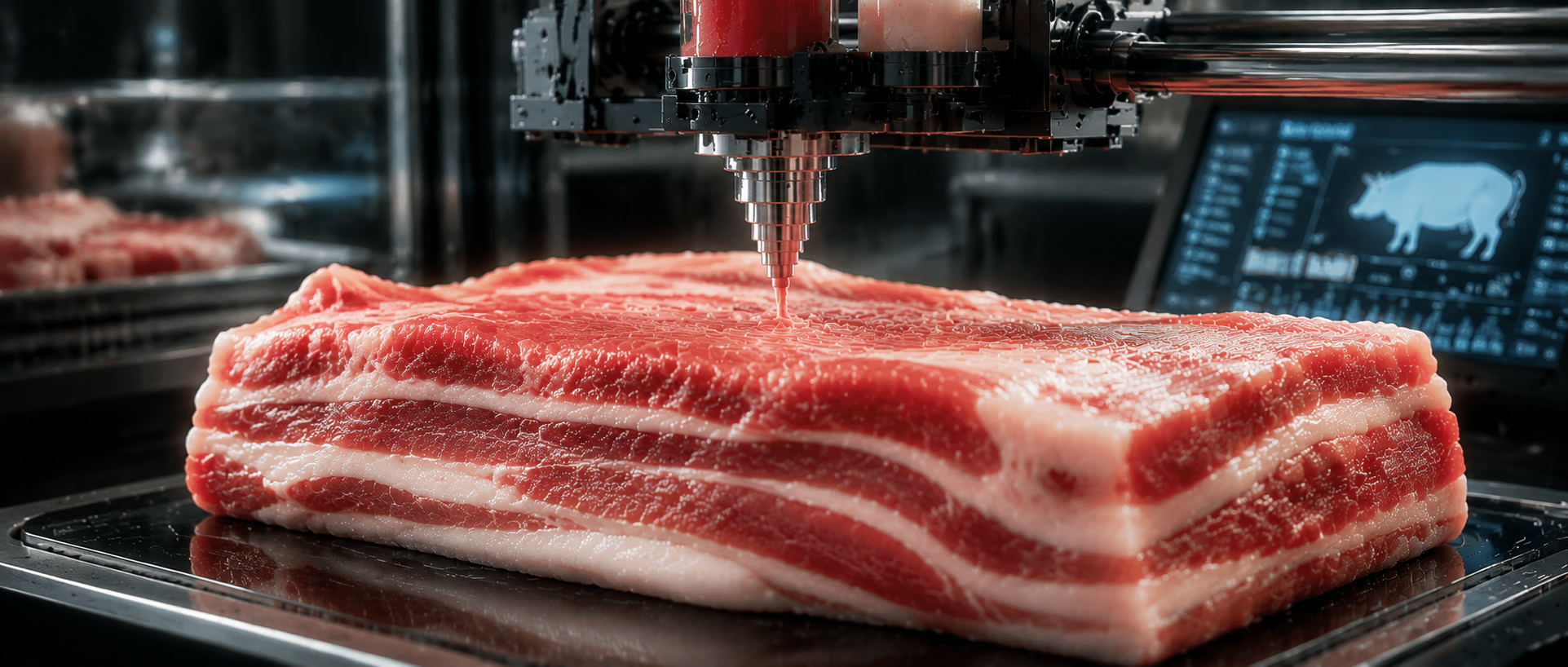
The key technology to bridge this gap is 3D bioprinting. Scientists load the cultured muscle cells, fat cells, and connective tissue cells into separate print nozzles. Computer programs precisely control the deposition position of each layer: where to lay down lean muscle fibers, where to embed fat marbling, and how to distribute the fascia—all parameters can be quantitatively adjusted.
Craving pork belly? Adjust the thickness and distribution of the fat layers. Prefer the texture of marbled beef? Redefine the cell arrangement pattern. After printing, these cells still need to be cultured for several days under specific conditions to form true biological connections between adjacent cells, generating the elasticity and toughness required for chewing.
This means that for the first time, humans can "design" the internal structure of meat like writing code. Ideal meat quality, which traditionally requires years of breeding and careful feeding, can theoretically be achieved directly through parameter adjustments.
A Meat Revolution Is Underway
The global investment of vast resources into cultured meat technology is not driven by curiosity, but forced by reality. The resource consumption of traditional livestock farming is staggering: a pig takes at least six months from birth to market weight, producing one kilogram of pork requires about six kilograms of feed and 600 liters of water. Nearly 80% of global agricultural land is used for livestock farming and its feed cultivation.
And demand continues to surge. According to multiple research institutions, global meat demand will increase by another 70% from current levels by 2050. Earth's land and water resources are already approaching their limits, and traditional farming models simply cannot handle this additional demand.
A more hidden crisis lies in the abuse of antibiotics. In high-density farms, pigs are continuously administered antibiotics from weaning—not because they are sick, but because overcrowded environments create extremely high risks of disease transmission, necessitating prophylactic medication for the entire herd. Over 70% of global antibiotics are used in livestock farming.
The direct consequence is the accelerated evolution of superbugs. The World Health Organization has listed antibiotic resistance as one of the top global health threats. When conventional antibiotics fail to treat infections, everyone will bear the cost of this crisis.
Cultured meat production takes place entirely in closed, sterile steel tanks, requiring no antibiotics and eliminating the risk of parasite and viral contamination. Just from a food safety perspective, it may be cleaner than traditional meats found in local markets.
But...
Cost Remains the Biggest Hurdle
In 2013, the world's first cultured meat burger was unveiled in the Netherlands, with a production cost of $250,000. The price of a single bite could have bought a house outright in a Chinese city. But the pace of technological iteration far exceeded expectations. In just over a decade, the production cost of cultured meat has plummeted from astronomical figures to dozens of dollars per kilogram. Industry experts widely predict that in five to ten years, its price will reach the tipping point where it matches ordinary pork.
China has not been absent from this race. In 2019, Professor Zhou Guanghong's team at Nanjing Agricultural University successfully cultivated China's first piece of cellular cultured meat. Although it weighed only 5 grams, it completed the crucial zero-to-one technical validation. By the end of 2025, the team achieved the world's first scaled production using a 2,000-liter bioreactor, with monthly outputs reaching hundreds of kilograms, propelling China into the global top three in cultured meat technology.
However, domestic authorities have not yet approved large-scale commercialization of cultured meat. Current product forms mainly focus on categories that don't require complex structures, such as patties, ground meat, sausages, and dumpling fillings.
If you want a piece of braised pork belly with distinct skin, tendon, and fat-and-lean layers, existing technology still cannot perfectly replicate it. Scientists acknowledge that breaking through this bottleneck will require at least several more years of R&D.
Both price and technology are approaching critical thresholds, but a more fundamental question remains unresolved.
The Biggest Question: Is Grown Meat Safe?
At the cellular level, its protein, fat, and amino acid composition differs fundamentally from traditional pork. The only difference lies in the growing environment: one develops inside a living animal, the other is cultured in a bioreactor. All countries that have approved its market launch require rigorous food safety reviews.
Of course, the impact of long-term, heavy consumption currently lacks sufficient time span for verification—after all, this technology has only existed for over a decade. But what this revolution truly overturns is not the taste of a particular dish, but the basic logic humanity has followed for thousands of years: to eat meat, you must raise an animal and then slaughter it. Today, pigpens have become steel tanks, feed has become nutrient solution, and slaughterhouses have turned into 3D printers. After eating pork for millennia, humans may finally satisfy their culinary desires without taking a life.
Perhaps in a few years, when you pick up a package of pork at the supermarket, the label won't read "free-range" or "grain-fed," but "printed today." When that day comes, facing this meat born from steel tanks and nozzles, will you unhesitatingly pick up your first chopstick, or put it down?
Let's add some deeper reflections—for instance, when food production is completely detached from life and death, are we violating the laws of nature? Defying the creator's will? The natural chain of survival of the fittest is completely broken. Are we, in the name of technology, transgressing some untouchable boundary?
Of course, only foolish humans would ponder such trivialities. For the pigs, they may finally escape the fate of confinement and slaughter, freely reproducing across the Earth as wild or companion animals, while humans continue to chew contentedly on braised pork "grown" in laboratories, as if all slaughter and sin have been completely erased by the hum of that 3D printer.
Is this a good thing or a bad thing? What do you think?